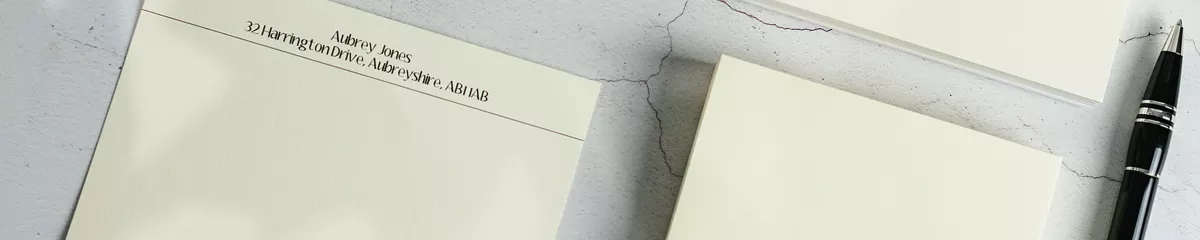
Collection: Correspondence Cards
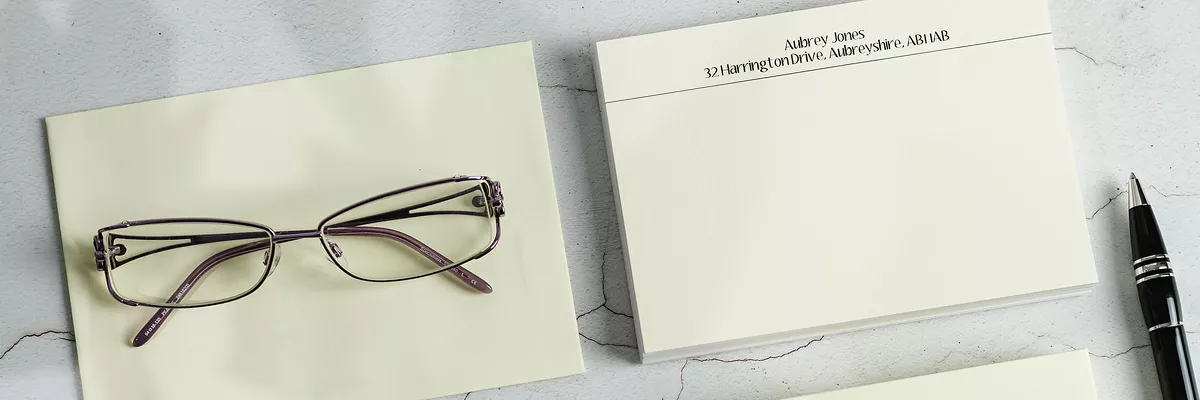
You can design your Correspondence Cards by selecting one of the many templates and personalising them to suit your style preferences.
Choose A6 or Demi Quarto cards in a selection of colours and smooth wove or textured laid finishes. Avaialble with premium quaility envelopes.
How to design your stationery
Start by choosing a correspondence card size and quality. View the collection to see the design templates that are available to create your design, all with customisable fonts, colours, text alignments, and underlines.Select a template to start creating your design and you'll get an instant proof of your artwork online. You'll be able to make as many revisions as you wish.
Size Help
A6
148x105mm - 5 3/4 x 4 1/8 inches
Demi Quarto
176x120mm - 7 x 4 3/4 inches
Paper Type Help
Smooth Wove
Wove Is a smooth, uncoated paper. If you're as old as me, you may have referred to it as bond paper back in the day. It Is the most popular stock for day-to-day writing at an entry-level price.
Textured Laid
Laid paper has a ribbed, textured surface that adds a tactile feel to the paper. It harks back to the times before the mechanisation of paper making.
Felt Marked
I love this paper. Whilst I call it the Old English range due to its soft shades of Old English White and Ivory, it comes from an Italian paper manufacturer that traces its origins to Verona in the late 1800s. The felt marking is subtle and created while the paper is still wet. The pattern is born with the paper: soft, natural, all over. I think of it as being akin to the surface of freshly fallen snow.
I'm often asked which paper is better . . . the answer is down to personal preference and budget.
Print Type Help
Digital
A cost effective full-colour flat print
Hot Foil Stamping
Make it shine! A metal die is stamped onto the paper with a heat activated coloured foil. The result is a sunken effect with glistening shine. Think gold foiling but it's not limited to gold.
Thermographic Raised
A raised print that is formed by sprinkling a resin powder onto wet ink. When heat is applied the resin melts to form a subtle raised effect.
Engraved Embossed
Engraving produces the finest quality stationery. It is not only something you see; it is something you feel. It's an ancient technique employing an engraved metal die that's filled with ink. The die is pressed onto the paper under great force. The result is an exquisite embossed (raised) print that excels with fine detail that is superior to thermography.
-
CollectionSpecificationColoursprices from
-
A6 148x105mm
A6 Ultra-Heavy Cards
Print: digital
-
White Wove
-
Cream Wove
-
Rosina Wove
-
Celeste Wove
-
Ostrica Wove
A6 Thermographic
Print: thermo
-
White Wove
-
Cream Wove
-
White Laid
-
Cream Laid
-
Demi Quarto 176x120mm
DQ Ultra-Heavy Cards
Print: digital
-
White Wove
-
Cream Wove
-
Rosina Wove
-
Celeste Wove
-
Ostrica Wove
DQ Thermographic
Print: thermo
-
White Wove
-
Cream Wove
-
White Laid
-
Cream Laid
DQ Engraved Old English
Print: engraved
-
Old English White
-
Old English Ivory